Basics of Waves Review
Navigate to:
Review Session Home - Topic Listing
Waves - Home || Printable Version || Questions with Links
Answers to Questions: All || #1-#14 || #15-#26 || #27-#38
|
15. The number of cycles of a periodic wave occurring per unit time is defined as a wave's ____.
a. wavelength. | b. period. | c. amplitude. | d. frequency. |
Answer: D This is a basic definition which you should know and be able to apply. |
Useful Web Links |
16. A periodic and repeating disturbance in a lake creates waves which emanate outward from its source to produce circular wave patterns. If the frequency of the source is 2.00 Hz and the wave speed is 5.00m/s then the distance between adjacent wave crests is ___ meter.
a. 0.200 | b. 0.400 | c. 1.25 | d. 2.50 | e. 10.0 |
Answer: D Let w=wavelength; then v = w*f. In this problem, it is given that v=5.00 m/s and f = 2.00 Hz. Substitution and algebra yields w = v / f = 2.50 m. |
Useful Web Links |
[ #15 | #16 | #17 | #18 | #19 | #20 | #21 | #22 | #23 | #24 | #25 | #26 ]
17. What is the frequency of a wave that has a speed of 0.4 m/s and a wavelength of 0.020 meter?
a. 10 hertz. | b. 20 hertz. | c. 0.008 hertz. | d. 0.5 hertz. |
Answer: B Let w=wavelength; then v = w*f. In this problem, it is given that v=5 m/s and w = .02 m. Substitution and algebra yields f=v/w=20 Hz. |
Useful Web Links |
[ #15 | #16 | #17 | #18 | #19 | #20 | #21 | #22 | #23 | #24 | #25 | #26 ]
18. Many wave properties are dependent upon other wave properties. Yet, one wave property is independent of all other wave properties. Which one of the following properties of a wave is independent of all the others?
a. wavelength | b. frequency | c. period | d. velocity |
Answer: D The speed of a wave is dependent upon the properties of the medium through which it moves, not upon the properties of the wave itself. |
Useful Web Links |
[ #15 | #16 | #17 | #18 | #19 | #20 | #21 | #22 | #23 | #24 | #25 | #26 ]
19. A pendulum makes exactly 40 vibrations in 20.0 s. Its period is ____. (Be cautious of the units.)
a. 0.500 Hz. | b. 0.500 s. | c. 2.00 Hz. | d. 2.00 s. | e. 8.00 x 10² Hz. |
Answer: B The period is the time for one complete cycle. If the pendulum takes 20.0 seconds for exactly 40 vibrational cycles, then it must take 0.500 second for one cycle. |
Useful Web Links |
[ #15 | #16 | #17 | #18 | #19 | #20 | #21 | #22 | #23 | #24 | #25 | #26 ]
20. A period of 0.005 seconds would be equivalent to a frequency of ____ Hz.
a. 20 | b. 50 | c. 200 | d. 500 | e. 2000 |
Answer: C The period and the frequency are related by a reciprocal relationship; that is, f = 1/T. |
Useful Web Links |
[ #15 | #16 | #17 | #18 | #19 | #20 | #21 | #22 | #23 | #24 | #25 | #26 ]
21. TRUE or FALSE:
The number of waves generated per second by a source is called the frequency of the source.
a. True | b. False |
Answer: A This is a basic definition which you should know and be able to apply. |
Useful Web Links |
[ #15 | #16 | #17 | #18 | #19 | #20 | #21 | #22 | #23 | #24 | #25 | #26 ]
22. TRUE or FALSE:
The SI unit for frequency is hertz.
a. True | b. False |
Answer: A Know this like the back of your hand. |
Useful Web Links |
[ #15 | #16 | #17 | #18 | #19 | #20 | #21 | #22 | #23 | #24 | #25 | #26 ]
23. TRUE or FALSE:
Doubling the frequency of a wave source (without altering the medium) doubles the speed of the waves.
a. True | b. False |
Answer: B Don't be fooled. Wave speed may equal frequency*wavelength. Yet doubling the frequency only halves the wavelength; wave speed remains the same. To change the wave speed, the medium would have to be changed. |
Useful Web Links |
24. If the frequency of a wave is doubled and if the speed remains constant, its wavelength is ____.
a. quartered. | b. halved. | c. unchanged. | d. doubled. |
Answer: B Wave speed equals frequency*wavelength. So doubling the frequency must halve the wavelength in order for wave speed to remain the same. |
Useful Web Links |
[ #15 | #16 | #17 | #18 | #19 | #20 | #21 | #22 | #23 | #24 | #25 | #26 ]
 25. Two different ropes with different mass densities are attached to each other. A pulse is introduced into one end of the rop and approaches the boundary as shown at the right. At the boundary, a portion of the energy is transmitted into the new medium and a portion is reflected. Which one of the diagrams below depicts the possible location and orientation of the pulse shortly after the incident pulse reaches the boundary?
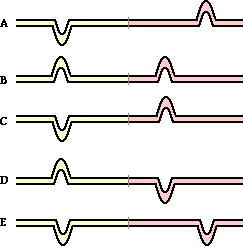
Answer: C The speeds in the two media can be deduced by the distance of the pulses from the boundary. In A and E, the speed is shown as fastest on the right, which makes the transmitted medium the less dense. Rule out A and E since a reflected pulse should not invert when moving from more dense to less dens. Rule out B for just the opposite reasons; the wave is moving from less to more dense and should invert upon reflection. Rule out D because the transmitted pulse never inverts. That leaves C as the answer. |
Useful Web Links |
[ #15 | #16 | #17 | #18 | #19 | #20 | #21 | #22 | #23 | #24 | #25 | #26 ]
26. When a pulse reaches a boundary between two different media, it will be____.
a. reflected, only. | b. transmitted, only. |
c. partly reflected and partly transmitted. | d. neither reflected nor transmitted. |
Answer: C This is basic information about the boundary behavior of waves. |
Useful Web Links |
[ #15 | #16 | #17 | #18 | #19 | #20 | #21 | #22 | #23 | #24 | #25 | #26 ]
Navigate to:
Review Session Home - Topic Listing
Waves - Home || Printable Version || Questions with Links
Answers to Questions: All || #1-#14 || #15-#26 || #27-#38
You Might Also Like ...
Users of The Review Session are often looking for learning resources that provide them with practice and review opportunities that include built-in feedback and instruction. If that is what you're looking for, then you might also like the following:- The Calculator Pad
The Calculator Pad includes physics word problems organized by topic. Each problem is accompanied by a pop-up answer and an audio file that explains the details of how to approach and solve the problem. It's a perfect resource for those wishing to improve their problem-solving skills.
Visit: The Calculator Pad Home | Calculator Pad - Vibrations and Waves
- Minds On Physics the App Series
Minds On Physics the App ("MOP the App") is a series of interactive questioning modules for the student that is serious about improving their conceptual understanding of physics. Each module of the series covers a different topic and is further broken down into sub-topics. A "MOP experience" will provide a learner with challenging questions, feedback, and question-specific help in the context of a game-like environment. It is available for phones, tablets, Chromebooks, and Macintosh computers. It's a perfect resource for those wishing to refine their conceptual reasoning abilities. Part 5 of the series includes topics on Wave Motion.
Visit: MOP the App Home || MOP the App - Part 5