Newton's Laws of Motion Review
Navigate to:
Review Session Home - Topic ListingNewton's Laws - Home || Printable Version || Questions with Links
Answers to Questions: All || #1-7 || #8-36 || #37-46 || #47-60
Part D: Drawing and Interpreting Free-Body Diagrams
37. Construct free-body diagrams for the following physical situations at the instant in time for which they are described. As is always done in free-body diagrams, label the forces according to type and draw the arrows such that their length reflects the magnitude of the force.
a. A book is at rest on top of a table.

| b. A book is being pushed to the right across a table surface with a constant velocity. (Neglect Fair.) 
| c. A book is being pushed to the right across a table surface and accelerating in the direction of the push. (Neglect Fair.) 
|
d. A student is pushing lightly upon a large box in an attempt to push it to the right across the floor, but the box fails to move. 
| e. A rightward-moving box (which was previously set into rightward motion across the floor) gradually slows to a stop.  | f. An air track glider is gliding to the right at constant velocity.  (or replace the Fnorm with Fair) |
g. A ball is dropped from rest from the top of a building. (Neglect Fair.) | h. Several seconds after being thrown, a football is moving upwards and rightwards towards the peak of its trajectory. (Neglect Fair.)
| i. Several seconds after being thrown, a football reaches the precise peak of its trajectory. (Neglect Fair.) |
j. A falling skydiver is speeding up. 
| k. A falling skydiver has reached a terminal velocity.  | l. After reaching a terminal velocity, a falling skydiver has opened her parachute.  |
m. A car is moving to the right at a high speed across a level roadway surface; the driver's foot remains on the gas pedal. 
| n. A car is skidding to a stop (with wheels locked) while traveling to the right across a level roadway surface. (Fair could be added to Ffrict)
| o. An elevator (held by a cable) is moving upwards at a constant velocity. (Neglect Fair.)  |
p. An upward moving elevator (held by a cable) slows down. (Neglect Fair.) 
| q. A downward moving elevator (held by a cable) slows down. (Neglect Fair.)  | r. A picture hangs symmetrically by two wires oriented at angles to the vertical.  |
Useful Web Links |
Part E: Force-Mass-Acceleration Relationships
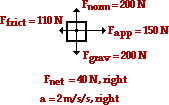
Construct free-body diagrams for the following objects; label the forces according to type. Use the approximation that g=10 m/s2
to determine the magnitude of all forces and the net force and acceleration of the object.
38. A 2-kg box is at rest on a table.  ("At rest" would indicate a balance of forces and an acceleration of 0 m/s/s.) | 39. A 2-kg box is free-falling from the table to the ground.  ("Free-falling" indicates that the only force that influences the motion is the force of gravity.) | 40. A 2-kg box equipped with a parachute is falling at a terminal velocity after being dropped from a plane. 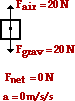 (A "terminal velocity" indicates a constant velocity and a balance of forces.) |
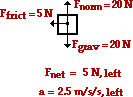
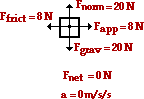
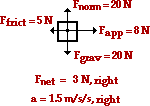


Useful Web Links |
Navigate to:
Review Session Home - Topic ListingNewton's Laws - Home || Printable Version || Questions with Links
Answers to Questions: All || #1-7 || #8-36 || #37-46 || #47-60
You Might Also Like ...
Users of The Review Session are often looking for learning resources that provide them with practice and review opportunities that include built-in feedback and instruction. If that is what you're looking for, then you might also like the following:- The Calculator Pad
The Calculator Pad includes physics word problems organized by topic. Each problem is accompanied by a pop-up answer and an audio file that explains the details of how to approach and solve the problem. It's a perfect resource for those wishing to improve their problem-solving skills.
Visit: The Calculator Pad Home | Calculator Pad - Newton's Laws
- Minds On Physics the App Series
Minds On Physics the App ("MOP the App") is a series of interactive questioning modules for the student that is serious about improving their conceptual understanding of physics. Each module of the series covers a different topic and is further broken down into sub-topics. A "MOP experience" will provide a learner with challenging questions, feedback, and question-specific help in the context of a game-like environment. It is available for phones, tablets, Chromebooks, and Macintosh computers. It's a perfect resource for those wishing to refine their conceptual reasoning abilities. Part 2 of the series includes Newton's Laws of Motion.
Visit: MOP the App Home || MOP the App - Part 2