Reflection of a Pulse at a Free End
Consider a pulse moving through a medium - perhaps through a rope or a slinky. What happens to the pulse when it reaches the end of that medium? The answer depends on whether the medium is fixed in space or free to move at its end. For example, if the pulse is moving through a rope and the end of the rope is held firmly by a person, then it could be said that the pulse is approaching a fixed end. On the other hand, if the end of the rope is lying on the floor such that it is free to move up or down when the pulse reaches its end, then it could be said that the pulse is approaching a free end.
The animation below depicts a pulse moving through a medium which is free to move at its end.
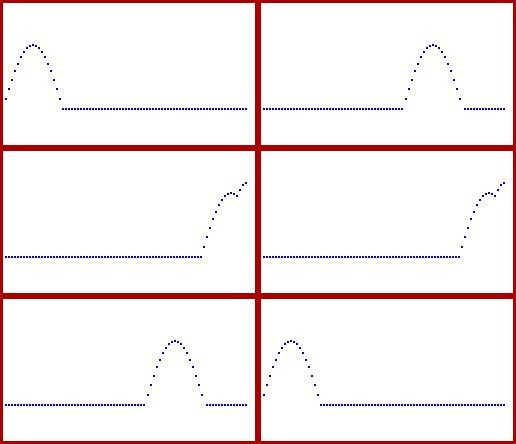
The animation depicts a boundary behavior phenomenon. The pulse reflects off the free end and returns with the same direction of displacement which it had before reflection. That is, a pulse with an upward displacement will reflect off the end and return with an upward displacement. Sometimes it is said that the pulse is not inverted. This behavior of non-inversion will always be observed when the end of the medium is free to move. This behavior of non-inversion is also observed when the medium is connected to another less heavy or less dense medium. In the latter case, when the pulse reaches the end of the medium, a portion of the pulse will reflect off the end and return with the same direction of displacement; it is not inverted. Since the medium beyond the end is less dense and less heavy, it fails to fix the medium's end and thus allows it to move; in this sense, the end of the medium ehaves as a free end.
In conclusion, a pulse reaching the end of a medium does not become inverted whenever it either
- reflects off a free end,
- or is moving in a more dense medium and reflects off a less dense medium.
For more information on physical descriptions of waves, visit The Physics Classroom Tutorial. Detailed information is available there on the following topics:
The Nature of a Wave
The Speed of a Wave
Boundary Behavior
Reflection, Refraction, and Diffraction of Waves
Return to List of Animations