First Harmonic
Standing Waves on a String
A standing wave pattern is a pattern which results from the interference of two or more waves along the same medium. All standing wave patterns are characterized by positions along the medium which are standing still. Such positions are referred to as nodal positions or nodes. Nodes occur at locations where two waves interfere such that one wave is displaced upward the same amount that a second wave is displaced downward. This form of interference is known as destructive interference and leads to a point of "no displacement." A node is a point of no displacement. Standing wave patterns are also characterized by antinodal positions - positions along the medium that vibrate back and forth between a maximum upward displacement to a maximum downward displacement. Antinodes are located at positions along the medium where the two interfering waves are always undergoing constructive interference. Standing wave patterns are always characterized by an alternating pattern of nodes and antinodes.
There are a variety of patterns which could be produced by vibrations within a string, slinky, or rope. Each pattern corresponds to vibrations which occur at a particular frequency and is known as a harmonic. The lowest possible frequency at which a string could vibrate to form a standing wave pattern is known as the fundamental frequency or the first harmonic. An animation of a string vibrating with the first harmonic is shown below.
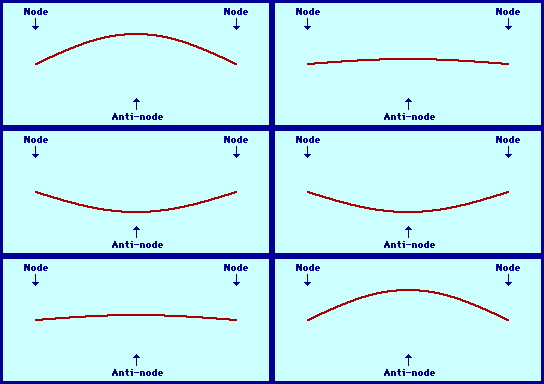
The frequency associated with each harmonic is dependent upon the speed at which waves move through the medium and the wavelength of the medium. The speed at which waves move through a medium is dependent upon the properties of the medium (tension of the string, thickness of the string, material composition of the string, etc.). The wavelength of the harmonic is dependent upon the length of the string and the harmonic number (first, second, third, etc.). Variations in either the properties of the medium or the length of the medium will result in variations in the frequency at which the string will vibrate.
For more information on physical descriptions of waves, visit The Physics Classroom Tutorial. Detailed information is available there on the following topics:
The Speed of a Wave
Traveling Waves vs. Standing Waves
Formation of Standing Waves
Nodes and Anti-nodes
Harmonics and Patterns
Mathematics of Standing Waves
Guitar Strings
Return to List of Animations