Echo vs. Reverberation
Sound is a mechanical wave which travels through a medium from one location to another. This motion through a medium occurs as one particle of the medium interacts with its neighboring particle, transmitting the mechanical motion and corresponding energy to it. This transport of mechanical energy through a medium by particle interaction is what makes a sound wave a mechanical wave.
As a sound wave reaches the end of its medium, it undergoes certain characteristic behaviors. Whether the end of the medium is marked by a wall, a canyon cliff, or the interface with water, there is likely to be some transmission/refraction, reflection and/or diffraction occurring. Reflection of sound waves off of barriers result in some observable behaviors which you have likely experienced. If you have ever been inside of a large canyon, you have likely observed an echo resulting from the reflection of sound waves off the canyon walls. Suppose you are in a canyon and you give a holler. Shortly after the holler, you would hear the echo of the holler - a faint sound resembling the original sound. This echo results from the reflection of sound off the distant canyon walls and its ultimate return to your ear. If the canyon wall is more than approximately 17 meters away from where you are standing, then the sound wave will take more than 0.1 seconds to reflect and return to you. Since the perception of a sound usually endures in memory for only 0.1 seconds, there will be a small time delay between the perception of the original sound and the perception of the reflected sound. Thus, we call the perception of the reflected sound wave an echo.
A reverberation is quite different than an echo. The distinction between an echo and a reverberation is depicted in the animation below.
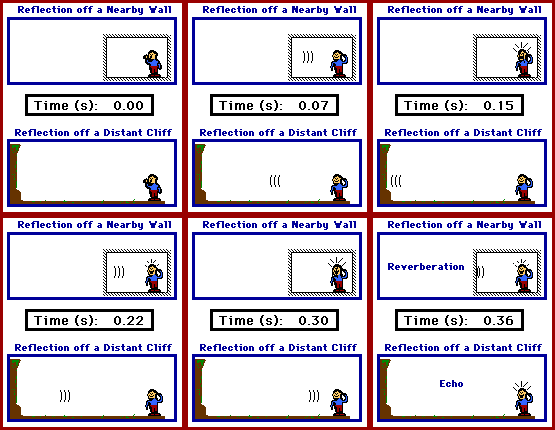
A reverberation is perceived when the reflected sound wave reaches your ear in less than 0.1 second after the original sound wave. Since the original sound wave is still held in memory, there is no time delay between the perception of the reflected sound wave and the original sound wave. The two sound waves tend to combine as one very prolonged sound wave. If you have ever sung in the shower (and we know that you have), then you have probably experienced a reverberation. The Pavarotti-like sound which you hear is the result of the reflection of the sounds you create combining with the original sounds. Because the shower walls are typically less than 17 meters away, these reflected sound waves combine with your original sound waves to create a prolonged sound - a reverberation.
For more information on physical descriptions of waves, visit The Physics Classroom Tutorial. Detailed information is available there on the following topics:
Nature of Sound as a Mechanical Wave
Propagation of a Sound Wave
Boundary Behaviors of Sound Waves
Reflection of Sound Waves
The Speed of Sound Waves
Sound Perception and the Human Ear
Acoustics
Return to List of Animations