Inducing a Positive Charge on a Sphere
There are a variety of methods to charge an object. One method is known as induction. In the induction process, a charged object is brought near but not touched to a neutral conducting object. The presence of a charged object near a neutral conductor will force (or induce) electrons within the conductor to move. The movement of electrons leaves an imbalance of charge on opposite sides of the neutral conductor. While the overall object is neutral (i.e., has the same number of electrons as protons), there is an excess of positive charge on one side of the object and an excess of negative charge on the opposite side of the object. Once the charge has been separated within the object, a ground is brought near and touched to one of the sides. The touching of the ground to the object permits a flow of electrons between the object and the ground. The flow of electrons results in a permanent charge being left upon the object. When an object is charged by induction, the charge received by the object is opposite the charge of the object which was used to charge it.
The animation below depicts the induction process. A neutral conducting sphere is at rest on top of an insulating stand. A negatively charged tube is brought near to (without touching) the neutral sphere. The presence of the negatively charged tube forces electron movement from the left to the right side of the sphere. This movement of electrons is merely a reaction to the presence of negative charge (like charges repel). Once touched by the ground, the electrons leave the sphere. When the tube is moved away, there is an overall positive charge left on the sphere.
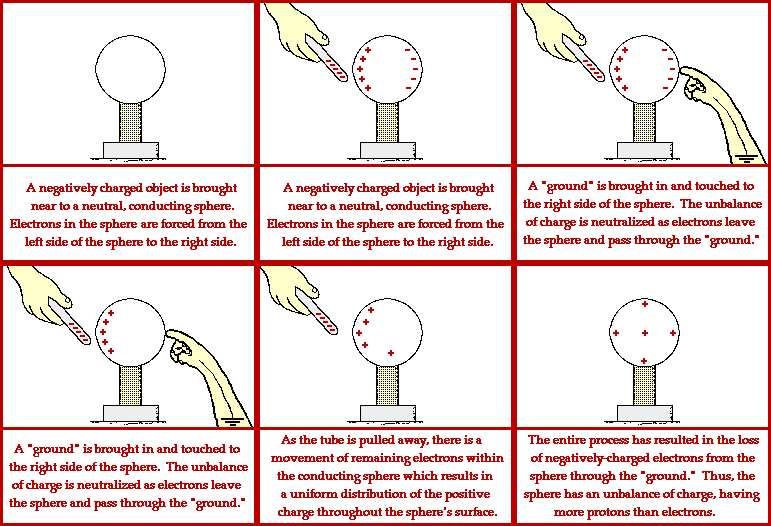
During the induction process, there is never any movement of electrons from the charged object to the sphere. The charged object is only used to induce electron movement. Electrons, being negatively charged, move about the conducting sphere as they are repelled by the negatively charged tube. Once the ground is touched to the sphere, the electrons can even move further from the negatively charged tube by leaving the sphere and moving through the ground. It is at this point that the sphere acquires an unbalance of charge. Since there was a loss of negative charge in the form of electrons, the overall charge on the sphere is positive.
The induction process is characterized by the following general features:
- A charged object is needed to charge an object by induction. Yet there is never any contact made between the charged object and the object being charged.
- Only conductors can be charged by the induction process. The process relies on the fact that a charged object can force or induce the movement of electrons about the material being charged.
- The object being charged ends up with a charge which is the opposite of the object being used to charge it.
- A ground must be used to charge on the object. The ground allows for electron movement into or out of the object being charged.
Additional information on physical descriptions of electrostatic phenomenon is available at The Physics Classroom Tutorial. Detailed information is available there on the following topics:
Neutral vs. Charged Objects
Charge Interactions
Conductors and Insulators
Polarization
Charging by Induction
Return to List of Animations