Charging an Electroscope by Induction Using a Negatively Charged Balloon
An electroscope is a common demonstration apparatus used by physics teachers to illustrate electrostatic principles of charging and charge interactions. The electroscope is most commonly used as a charge-detecting device. The electroscope shown in the animation below consists of a plate (near the top), a support stand (which connects to the plate and extends through the center of the scope), and a needle which rests upon the support stand and is free to rotate about its pivot. The plate, support stand, and needle are all made of a conducting material which allows for both the free flow of electrons and the distribution of any excess charge throughout the electroscope. By observing any deflection of the needle, the presence of charge in either the electroscope or a nearby object can be determined.
One common demonstration performed with the electroscope involves the induction process of charging. In the induction process of charging, a charged object is brought near to but not touching the electroscope. The presence of the charged object above the plate of the electroscope, induces electrons within the electroscope to move accordingly. With the charged object still held above the plate, the electroscope is touched. At this point electrons will flow between the electroscope and the ground, giving the electroscope an overall charge. When the charged object is pulled away, the needle of the electroscope deflects, thus indicating an overall charge on the electroscope. The process of charging an electroscope by induction using a negatively charged balloon is depicted in the animation below.
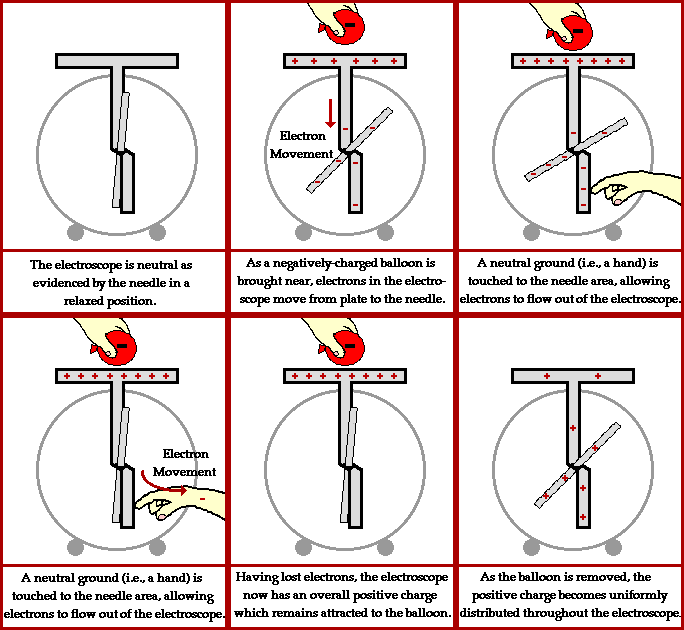
As shown in the animation above, the presence of the negatively charged balloon above the plate of the electroscope will induce the movement of electrons from the plate of the electroscope to the support and needle of the electroscope. This is explained by the like charges repel principle. The negatively charged balloon repels the negatively charged electrons, thus forcing them to move downwards. Once the electrons leave the plate and enter the needle, both plate and support/needle acquire an imbalance of charge. The plate acquires an excess of positive charge (since electrons have left this once neutral region) and the support/needle acquires an excess of negative charge (since electrons have entered this once neutral region).
Once charge within the electroscope has been polarized (i.e., separated into opposite types), the bottom of the electroscope is touched by a finger. Being repelled by the negatively charged balloon, electrons from the electroscope exit and enter into the ground. Once more, this process is driven by the principle that like charges repel. The electrons, having a mutual repulsion for one another and for the negatively charged balloon, choose to exit the electroscope and enter into the larger region. By doing so, the electrons are able to distance themselves and so minimize the repulsive interactions. It is at this point in the induction process that the electroscope acquires an overall charge. Since electrons have left the electroscope, the overall charge on it is positive. In general, the induction process will always place a charge on the object which is the opposite type of charge possessed by the object used to charge it.
It might be noted in the animation above that while the departure of electrons may leave the electroscope with an overall charge, the needle is still not deflected. The excess of positive charge remains localized in the plate of the electroscope, being strongly attracted to the negative charge of the balloon. Once the balloon is withdrawn, there is a movement of any remaining electrons in such a way that the positive excess charge becomes distributed about the entire electroscope. At this point, the needle of the electroscope becomes deflected and shows the presence of charge.
Additional information on physical descriptions of electrostatic phenomenon is available at The Physics Classroom Tutorial. Detailed information is available there on the following topics:
Neutral vs. Charged Objects
Charge Interactions
Conductors and Insulators
Polarization
Charging by Induction
Return to List of Animations