Charging an Electrophorus by Induction Using a Negatively Charged Object
A common physics demonstration involves the charging of an aluminum pie plate by the process of induction. The demonstration typically involves the following steps.
- Acquire a charged object (e.g., a balloon or Styrofoam plate) made of a non-conducting material.
- Using an insulating handle on the aluminum plate, bring the aluminum plate near to but not touching the Styrofoam plate.
- Touch the rim of the aluminum plate with your finger.
- Move the aluminum plate away from the charged object.
A Styrofoam plate is often used as the charged object to induce a charge separation within the aluminum plate. If the Styrofoam plate is rubbed with wool or animal fur, then the Styrofoam acquires a negative charge. Having a greater electron affinity than the wool (or animal fur), the Styrofoam will attract electrons away from the atoms of the wool. Thus, the Styrofoam becomes negatively charged.
The animation below depicts the result of the remainder of this induction procedure.
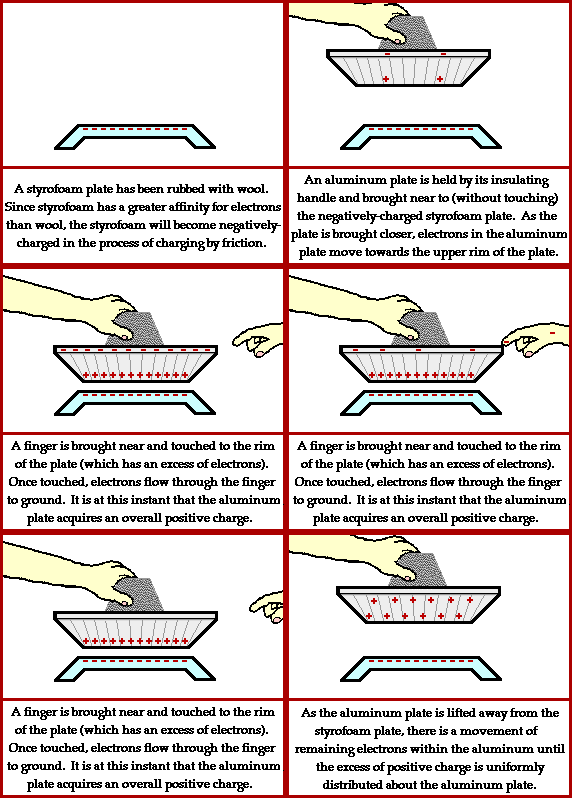
When the aluminum plate is held near the negatively charged Styrofoam plate, electrons within the aluminum plate will be repelled by the negatively charged Styrofoam. These electrons will move from the bottom surface of the aluminum plate to the rim of the aluminum plate. This leaves the bottom of the aluminum plate with an excess of positive charge and the rim of the aluminum plate with an excess of negative charge. It could be said that the Styrofoam has served to polarize the aluminum plate - i.e., to separate its positive charge from its negative charge. While there may be a separation of charge within the aluminum plate, the overall charge of the plate is zero. Once the aluminum plate is touched, electrons move from the aluminum plate to the ground. It is at this instant that the aluminum plate acquires an overall positive charge. This excess of positive charge remains localized near the bottom of the aluminum plate due to its attraction to the Styrofoam plate. As the aluminum plate is lifted away from the Styrofoam plate, there is a movement of remaining electrons within the aluminum plate such that the excess positive charge becomes distributed about the aluminum plate.
Additional information on physical descriptions of electrostatic phenomenon is available at The Physics Classroom Tutorial. Detailed information is available there on the following topics:
Neutral vs. Charged Objects
Charge Interactions
Polarization
Charging by Induction
Return to List of Animations