Skydiving
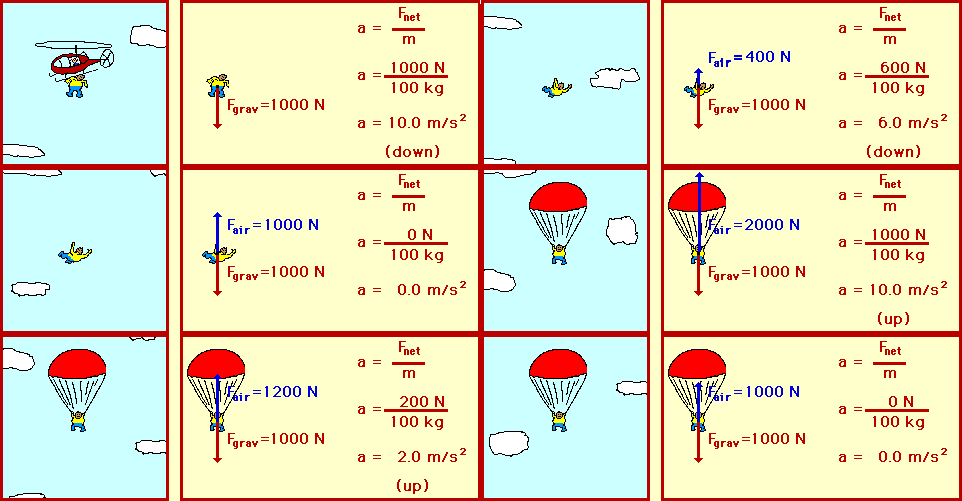
Observe the motion of the skydiver below. As the skydiver falls, he encounters the force of air resistance. The amount of air resistance is dependent upon two variables:
- The speed of the skydiver
As a skydiver falls, he accelerates downwards, gaining speed with each second. The increase in speed is accompanied by an increase in air resistance (as observed in the animation below). This force of air resistance counters the force of gravity. As the skydiver falls faster and faster, the amount of air resistance increases more and more until it approaches the magnitude of the force of gravity. Once the force of air resistance is as large as the force of gravity, a balance of forces is attained and the skydiver no longer accelerates. The skydiver is said to have reached a terminal velocity.
- The cross-sectional area of the skydiver
A skydiver in the spread eagle position encounters more air resistance than a skydiver who assumes the tuck position or who falls feet (or head) first. The greater cross-sectional area of askydiver in the spread eagle position leads to a greater air resistance and a tendency to reach a slower terminal velocity. The importance of cross-sectional area to skydiving is also demonstrated by the use of a parachute. An open parachute increases the cross-sectional area of the falling skydiver and thus increases the amount of air resistance which he encounters (as observed in the animation below). Once the parachute is opened, the air resistance overwhelms the downward force of gravity. The net force and the acceleration on the falling skydiver is upward. An upward net force on a downward falling object would cause that object to slow down. The skydiver thus slows down. As the speed decreases, the amount of air resistance also decreases until once more the skydiver reaches a terminal velocity.
For more information on physical descriptions of motion, visit The Physics Classroom Tutorial. Detailed information is available there on the following topics:
Newton's First Law of Motion
Newton's Second Law of Motion
Free-Body Diagrams
Free Fall vs. Air Resistance
Return to List of Animations