Skip to Content Go to sign in Skip to Primary Navigation Skip to Page Navigation Skip to Header Navigation Skip to Footer Navigation Toggle Accessibility Options or learn more about accessability

Physics Classroom is making strides to make our site accessible to everyone, and features many accessibility features.

Our site contains 6 navigation areas. The Primary, Secondary, and Page Level navigations have a screen reader version of their nav structure that allows using the left and right keys to navigate sibling navigation items, and up or down keys to navigate parent or child navigation items. The others can be navigated using tabs.

Within the main content, we leverage headers to provide in page or in tool navigation.

Although we are still rebuilding our content to leverage these tools, our images should have both short and verbose descriptions, the later describing in great detail the image for those who cannot see. Any formulas found within the images are often in the image figure below the image.

Equations and formulas are rendered using MathJax, which has both verbal, braille (including nemath braille), and keyboard navigation within them. Learn how to configure and leverage this for various screen readers on our Equation Navigation Page.

While not every area of Physics Classroom is usable purely from keyboard and screen reader, we are committed to continue work on making this possible. If you have questions or need additional help, please use this link to contact us .

Return to screen reader navigation

Negative Velocity and Positive Acceleration

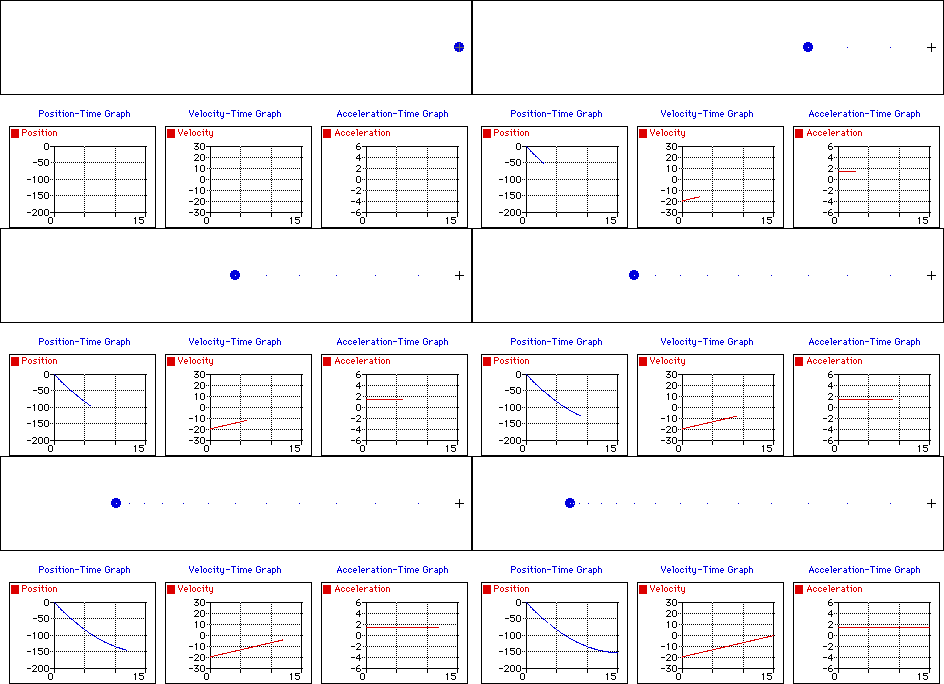
Observe that the object below moves in the negative direction with a changing velocity. An object which moves in the negative direction has a negative velocity. If the object is slowing down then its acceleration vector is directed in the opposite direction as its motion (in this case, a positive acceleration). The dot diagram shows that each consecutive dot is not the same distance apart (i.e., a changing velocity). The position-time graph shows that the slope is changing (meaning a changing velocity) and negative (meaning a negative velocity). The velocity-time graph shows a line with a positive (upward) slope (meaning that there is a positive acceleration); the line is located in the negative region of the graph (corresponding to a negative velocity). The acceleration-time graph shows a horizontal line in the positive region of the graph (meaning a positive acceleration).
For more information on physical descriptions of motion, visit The Physics Classroom Tutorial. Detailed information is available there on the following topics:

Ticker Tape Diagrams

Meaning of Acceleration

Position-Time Graphs

Velocity-Time Graphs
 
Tired of Ads? Go Ad Free ($5/year))