Vector Addition
This web page is designed to provide some additional practice with the use of scaled vector diagrams for the addition of two or more vectors. Your time will be best spent if you read each practice problem carefully, attempt to solve the problem with a scaled vector diagram, and then check your answer. You are cautioned to avoid making a quick reference to the solution prior to making your own attempt at the solution. Such a habit is likely to fail at nurturing the ability to draw a scaled vector addition diagram. If the solution to these practice problems are still not meaningful, you are encouraged to obtain some on-line help in The Physics Classroom. Visit the page on vector addition.
NOTE: Since your answers were determined using a scaled vector diagram, small errors in the measurement of the direction and magnitude of any one of the vectors may lead to small differences between your answers and the correct ones which are shown here. Do not have a cow.
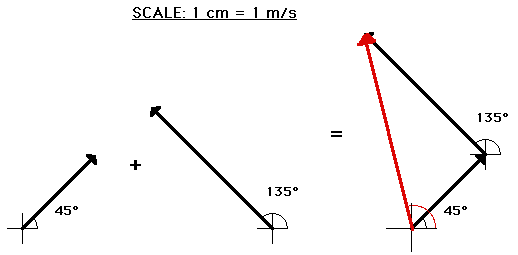
1. Add the following vectors and determine the resultant.
3.0 m/s, 45 deg and 5.0 m/s, 135 deg
Show/Hide Answer and Solution</div>" role="button" tabindex="0">
Show/Hide Answer and Solution
3.0 m/s, 45 deg + 5.0 m/s, 135 deg = 5.83 m/s, 104 deg (Note: the resultant is drawn in red.)
2. Add the following vectors and determine the resultant.
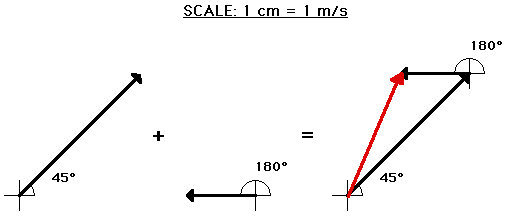
5.0 m/s, 45 deg and 2.0 m/s, 180 deg
Show/Hide Answer and Solution</div>" role="button" tabindex="0">
Show/Hide Answer and Solution
5.0 m/s, 45 deg + 2.0 m/s, 180 deg = 3.85m/s, 66.5 deg (Note: the resultant is drawn in red.)
3. Add the following vectors and determine the resultant.
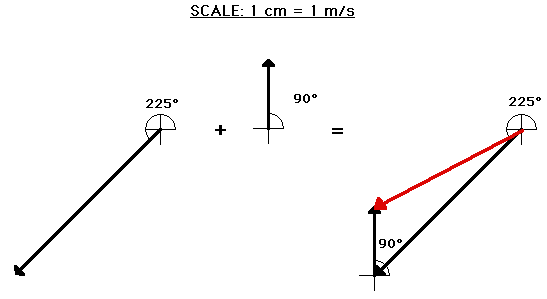
6.0 m/s, 225 deg and 2.0 m/s, 90 deg
Show/Hide Answer and Solution</div>" role="button" tabindex="0">
Show/Hide Answer and Solution
6.0 m/s, 225 deg+ 2.0 m/s, 90 deg= 4.80 m/s, 207.9 deg (Note: the resultant is drawn in red.)
4. Add the following vectors and determine the resultant.
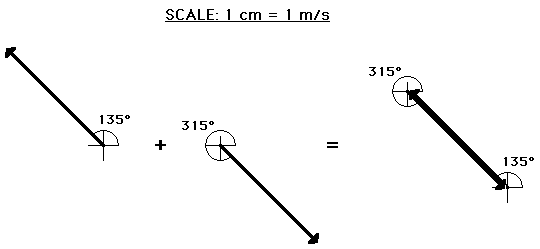
4.0 m/s, 135 deg and 4.0 m/s, 315 deg
Show/Hide Answer and Solution</div>" role="button" tabindex="0">
Show/Hide Answer and Solution
4.0 m/s, 135 deg+ 4.0 m/s, 315 deg = 0 m/s (Note: the resultant is drawn in red.)
5. Add the following vectors and determine the resultant.
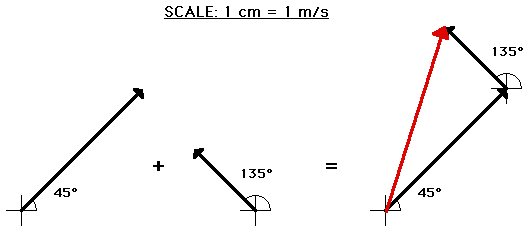
5.0 m/s, 45 deg and 2.5 m/s, 135 deg
Show/Hide Answer and Solution</div>" role="button" tabindex="0">
Show/Hide Answer and Solution
5.0 m/s, 45 deg+ 2.5 m/s, 135 deg= 5.59 m/s, 71.6 deg (Note: the resultant is drawn in red.)
6. Add the following vectors and determine the resultant.
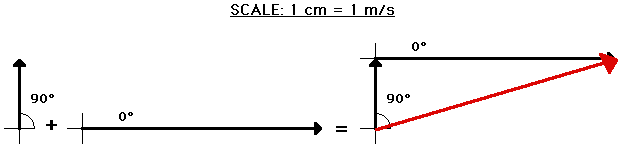
7.0 m/s, 0 deg and 2.0 m/s, 90 deg
Show/Hide Answer and Solution</div>" role="button" tabindex="0">
Show/Hide Answer and Solution
7.0 m/s, 0 deg+ 2.0 m/s, 90 deg= 7.28 m/s, 15.9 deg (Note: the resultant is drawn in red.)
7. Add the following vectors and determine the resultant.
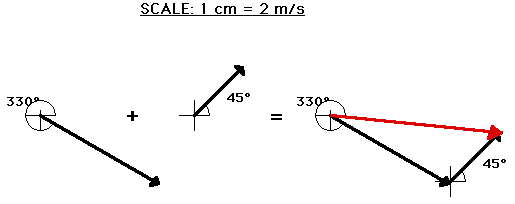
8.0 m/s, 330 deg and 4.0 m/s, 45 deg
Show/Hide Answer and Solution</div>" role="button" tabindex="0">
Show/Hide Answer and Solution
8.0 m/s, 330 deg+ 4.0 m/s, 45 deg= 9.83m/s, 352.2 deg (Note: the resultant is drawn in red.)
8. Add the following vectors and determine the resultant.
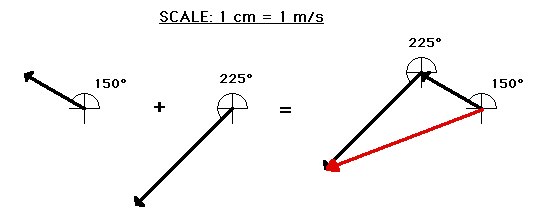
2.0 m/s, 150 deg and 4.0 m/s, 225 deg
Show/Hide Answer and Solution</div>" role="button" tabindex="0">
Show/Hide Answer and Solution
2.0 m/s, 150 deg+ 4.0 m/s, 225 deg= 4.91m/s, 201.8 deg (Note: the resultant is drawn in red.)
9. Add the following vectors and determine the resultant.
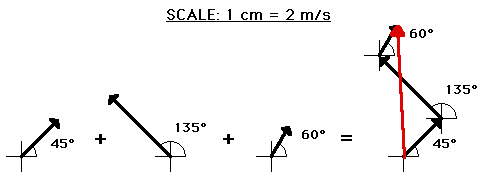
3.0 m/s, 45 deg and 5.0 m/s, 135 deg and 2.0 m/s, 60 deg
Show/Hide Answer and Solution</div>" role="button" tabindex="0">
Show/Hide Answer and Solution
3.0 m/s, 45 deg+ 5.0 m/s, 135 deg+ 2.0 m/s, 60 deg= 7.40m/s, 93.2 deg (Note: the resultant is drawn in red.)
10. Add the following vectors and determine the resultant.
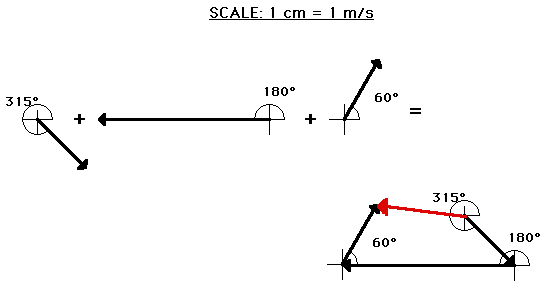
2.0 m/s, 315 deg+ 5.0 m/s, 180 deg+ 2.0 m/s, 60 deg= 2.61m/s, 173 deg
Show/Hide Answer and Solution</div>" role="button" tabindex="0">
Show/Hide Answer and Solution
2.0 m/s, 315 deg+ 5.0 m/s, 180 deg+ 2.0 m/s, 60 deg= 2.61m/s, 173 deg (Note: the resultant is drawn in red.)
11. Add the following vectors and determine the resultant.
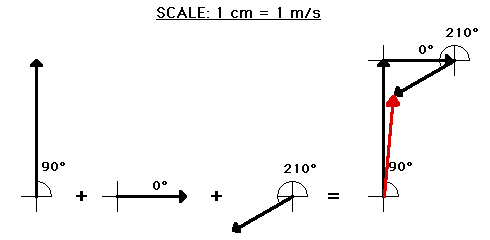
4.0 m/s, 90 deg and 2.0 m/s, 0 deg and 2.0 m/s, 210 deg
Show/Hide Answer and Solution</div>" role="button" tabindex="0">
Show/Hide Answer and Solution
4.0 m/s, 90 deg+ 2.0 m/s, 0 deg+ 2.0 m/s, 210 deg= 3.01 m/s, 84.9 deg (Note: the resultant is drawn in red.)
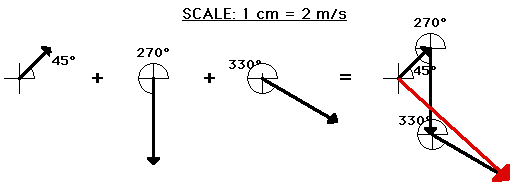
12. Add the following vectors and determine the resultant.
2.5 m/s, 45 deg and 5.0 m/s, 270 deg and 5.0 m/s, 330 deg
Show/Hide Answer and Solution</div>" role="button" tabindex="0">
Show/Hide Answer and Solution
2.5 m/s, 45 deg+ 5.0 m/s, 270 deg+ 5.0 m/s, 330 deg= 8.37 m/s, 316.8 deg (Note: the resultant is drawn in red.)