Standing Wave Formation
The animation below depicts two waves moving through a medium in opposite directions. The blue wave is moving to the right and the green wave is moving to the left. As is the case in any situation in which two waves meet while moving along the same medium, interference occurs. The blue wave and the green wave interfere to form a new wave pattern known as the resultant. The resultant in the animation below is shown in black. The resultant is merely the result of the two individual waves - the blue wave and the green wave - added together in accordance with the principle of superposition.
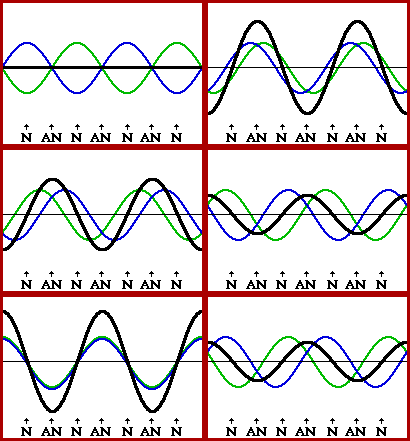
The result of the interference of the two waves above is a new wave pattern known as a standing wave pattern. Standing waves are produced whenever two waves of identical frequency interfere with one another while traveling opposite directions along the same medium. Standing wave patterns are characterized by certain fixed points along the medium which undergo no displacement. These points of no displacement are called nodes (nodes can be remembered as points of no desplacement). The nodal positions are labeled by an N in the animation above. The nodes are always located at the same location along the medium, giving the entire pattern an appearance of standing still (thus the name "standing waves"). A careful inspection of the above animation will reveal that the nodes are the result of the destructive interference of the two interfering waves. At all times and at all nodal points, the blue wave and the green wave interfere to completely destroy each other, thus producing a node.
Midway between every consecutive nodal point are points which undergo maximum displacement. These points are called antinodes; the anti-nodal nodal positions are labeled by an AN. Antinodes are points along the medium which oscillate back and forth between a large positive displacement and a large negative displacement. A careful inspection of the above animation will reveal that the antinodes are the result of the constructive interference of the two interfering waves.
In conclusion, standing wave patterns are produced as the result of the repeated interference of two waves of identical frequency while moving in opposite directions along the same medium. All standing wave patterns consist of nodes and antinodes. The nodes are points of no displacement caused by the destructive interference of the two waves. The antinodes result from the constructive interference of the two waves and thus undergo maximum displacement from the rest position.
For more information on physical descriptions of waves, visit The Physics Classroom Tutorial. Detailed information is available there on the following topics:
The Speed of a Wave
Traveling Waves vs. Standing Waves
Formation of Standing Waves
Nodes and Anti-nodes
Harmonics and Patterns
Mathematics of Standing Waves
Guitar Strings
Return to List of Animations