Skip to Content Go to sign in Skip to Primary Navigation Skip to Page Navigation Skip to Header Navigation Skip to Footer Navigation Toggle Accessibility Options or learn more about accessability

Physics Classroom is making strides to make our site accessible to everyone, and features many accessibility features.

Our site contains 6 navigation areas. The Primary, Secondary, and Page Level navigations have a screen reader version of their nav structure that allows using the left and right keys to navigate sibling navigation items, and up or down keys to navigate parent or child navigation items. The others can be navigated using tabs.

Within the main content, we leverage headers to provide in page or in tool navigation.

Although we are still rebuilding our content to leverage these tools, our images should have both short and verbose descriptions, the later describing in great detail the image for those who cannot see. Any formulas found within the images are often in the image figure below the image.

Equations and formulas are rendered using MathJax, which has both verbal, braille (including nemath braille), and keyboard navigation within them. Learn how to configure and leverage this for various screen readers on our Equation Navigation Page.

While not every area of Physics Classroom is usable purely from keyboard and screen reader, we are committed to continue work on making this possible. If you have questions or need additional help, please use this link to contact us .

Return to screen reader navigation

Average vs. Instantaneous Speed

During a typical trip to school, your car will undergo a series of changes in its speed. If you were to inspect the speedometer readings at regular intervals, you would notice that it changes often. The speedometer of a car reveals information about the instantaneous speed of your car. It shows your speed at a particular instant in time.
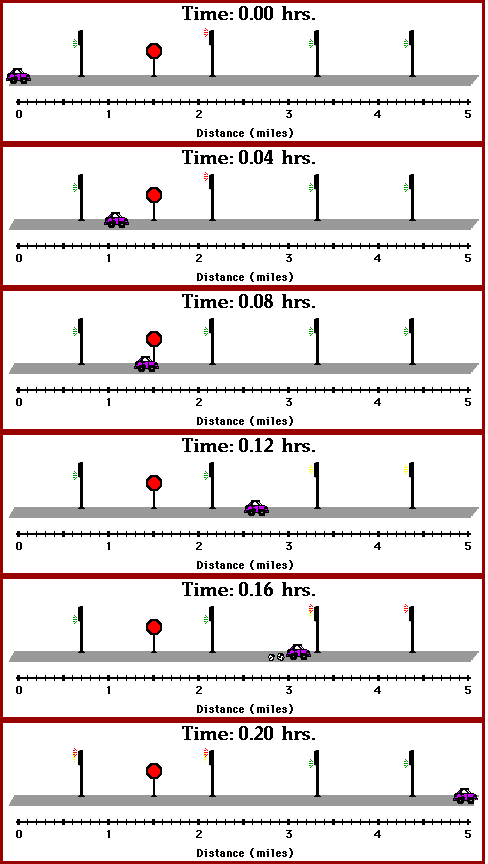
The instantaneous speed of an object is not to be confused with the average speed. Average speed is a measure of the distance traveled in a given period of time; it is sometimes referred to as the distance per time ratio. Suppose that during your trip to school, you traveled a distance of 5 miles and the trip lasted 0.2 hours (12 minutes). The average speed of your car could be determined as

On the average, your car was moving with a speed of 25 miles per hour. During your trip, there may have been times that you were stopped and other times that your speedometer was reading 50 miles per hour. Yet, on average, you were moving with a speed of 25 miles per hour.

For more information on physical descriptions of motion, visit The Physics Classroom Tutorial. Specific information is available there on the following topic:

Instantaneous vs. Average Speed
 
Tired of Ads? Go Ad Free ($5/year))