Grounding a Negatively Charged Electroscope
An electroscope is a charge-detecting device which depicts the presence of a charge on the apparatus itself or upon other objects in the nearby vicinity. The presence of a charge on an electroscope is depicted by the deflection of its needle from its usual upright position. The needle, being free to rotate about its pivot, will be deflected whenever the charge in the needle is the same as the charge in the upright support upon which it balances. Since the electroscope plate, support, and needle are connected and made of a conducting material, any charge upon the electroscope will be distributed about the entire conductor. Thus, if an electroscope acquires an overall negative charge, this negative charge will be spread about the entire electroscope - plate, support and needle. Since like charges repel, the negatively charged support and the negatively charged needle will repel each other, causing a deflection of the needle.
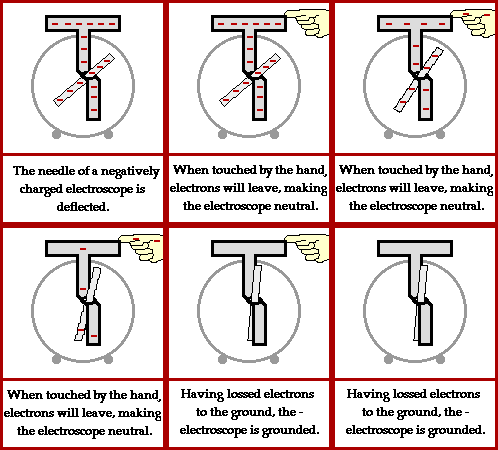
When the negatively charged electroscope is touched, its charge becomes grounded (or neutralized). This is depicted in the animation below. The grounding process involves a transfer of electrons between the charged electroscope and the conducting object to which it is touched. When a negatively charged electroscope is touched, electrons leave the electroscope to the ground. Since electrons repel other electrons, their tendency is to spread out as far as possible through any conductor. To excess electrons, the farther away that they can be from one another, the better. When touched by a larger conducting material (in this case, a person), the electrons have an opportunity to spread out even further by using the vast space of the ground. The excess electrons leave the electroscope, thus neutralizing its overall charge. As the electroscope loses its charge, the needle relaxes back to its naturally upright position.
Additional information on physical descriptions of electrostatic phenomenon is available at The Physics Classroom Tutorial. Detailed information is available there on the following topics:
Neutral vs. Charged Objects
Charge Interactions
Polarization
Grounding - the Removal of a Charge
Return to List of Animations