Uniform Circular Motion
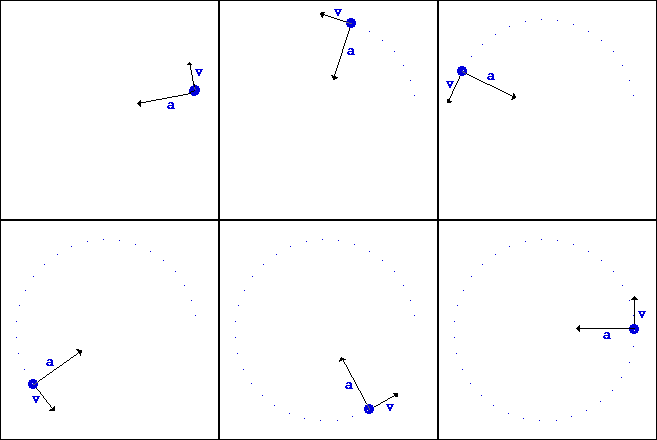 Uniform circular motion can be described as the motion of an object in a circle at a constant speed. As an object moves in a circle, it is constantly changing its direction. At all instances, the object is moving tangent to the circle. Since the direction of the velocity vector is the same as the direction of the object's motion, the velocity vector is directed tangent to the circle as well. The animation at the right depicts this by means of a vector arrow.
An object moving in a circle is accelerating. Accelerating objects are objects which are changing their velocity - either the speed (i.e., magnitude of the velocity vector) or the direction. An object undergoing uniform circular motion is moving with a constant speed. Nonetheless, it is accelerating due to its change in direction. The direction of the acceleration is inwards. The animation at the right depicts this by means of a vector arrow.
The final motion characteristic for an object undergoing uniform circular motion is the net force. The net force acting upon such an object is directed towards the center of the circle. The net force is said to be an inward or centripetal force. Without such an inward force, an object would continue in a straight line, never deviating from its direction. Yet, with the inward net force directed perpendicular to the velocity vector, the object is always changing its direction and undergoing an inward acceleration.
For more information on physical descriptions of motion, visit The Physics Classroom Tutorial. Detailed information is available about the following topics:
Velocity
Acceleration
Net Force and Acceleration
Circular Motion and Tangential Velocity
Circular Motion and Acceleration
The Centripetal Force Requirement
Return to List of Animations