Inertia and the Right Hand Turn
Many students of physics do not believe in centripetal ("inwards") forces. Even after completion of a thorough physics course, such students will still incorrectly believe that an object moving in a circle experiences an outward force. Perhaps the reason for adhering to this misconception stems from their experiences with riding as a passenger in automobiles and amusement park rides.
Imagine that you are a passenger in a car which is making a right-hand turn. As the car begins to take the turn to the right, you often feel as though you are sliding to the left. The car is turning to the right due to the inward force, yet you feel as though you are being forced leftward or outward. In actuality, the car is beginning its turning motion (to the right) while you continue in a straight line path. This motion can be better understood by examining the animation below.
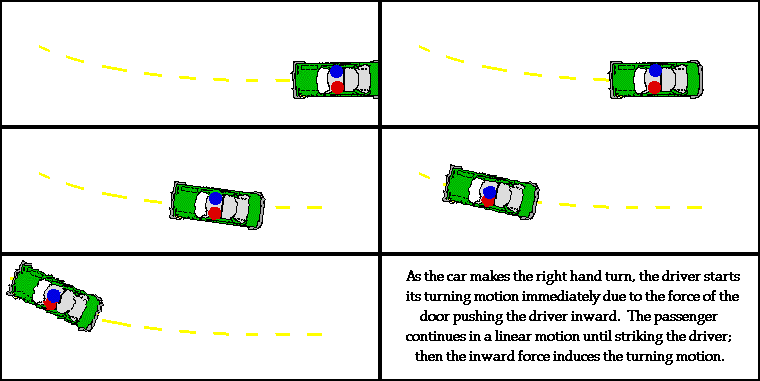
Observe in the animation that the passenger (in blue) continues in a straight-line motion for a short period of time after the car begins to make its turn. In fact, the passenger follows a straight-line path until striking the shoulder of the driver (in red). Once striking the driver, a force is applied to the passenger to force the passenger to the right and thus complete the turn.
An inward net force is required to make a turn in a circle. This inward net force requirement is known as a centripetal force requirement. In the absence of any net force, an object in motion (such as the passenger) continues in motion in a straight line at constant speed. This is Newton's first law of motion. While the car begins to make the turn, the passenger and the seat begin to edge rightward. In a sense, the car is beginning to slide out from under the passenger. Once striking the driver, the passenger can now turn with the car and experience some circle-like motion. There is never any outward force exerted upon the passenger. The passenger is either moving straight ahead in the absence of a force or moving along a circular path in the presence of an inward-directed force.
For more information on physical descriptions of motion, visit The Physics Classroom Tutorial. Detailed information is available about the following topics:
Acceleration
Net Force and Acceleration
Circular Motion and Tangential Velocity
Circular Motion and Acceleration
The Centripetal Force Requirement
Free Body Diagrams
Addition of Forces
Return to List of Animations